New Study Finds Workforce Challenges Emerge as a Top Concern Among CPG Manufacturers
August 27, 2024
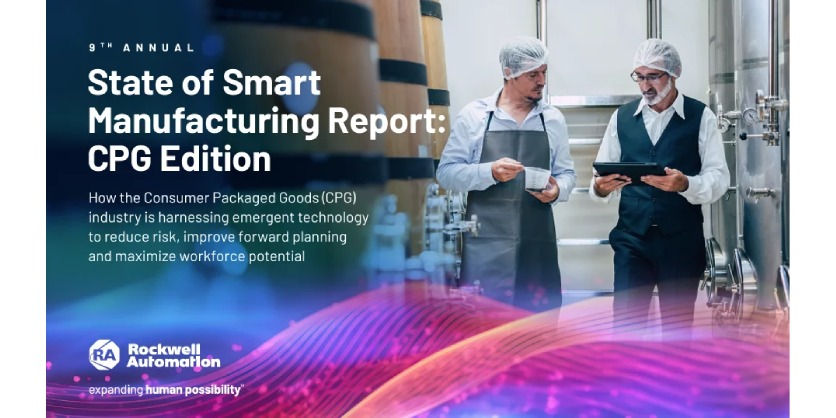
Global study reveals critical workforce issues, rising technology budgets, and evolving strategic priorities for CPG manufacturers.
Rockwell Automation, Inc. one of the world’s largest companies dedicated to industrial automation and digital transformation, have announced the results of the 9th annual “State of Smart Manufacturing Report: CPG Edition.” The global study encompasses the responses of 158 leaders from CPG manufacturers, inclusive of home and personal care, as well as food and beverage manufacturers, across 17 of the leading manufacturing countries.
This year’s report highlights the evolution of the CPG industry, specifically about utilizing emerging technologies to maximize workforce potential, improve forward planning and minimize risk. CPG leaders acknowledge that neglecting to adapt to the industry’s transformation can stifle growth and competitiveness, especially considering that the manufacturing sector could see up to 2.1 million unfilled jobs by 2030
if current workforce challenges are not addressed.
Key global findings include:
- Workforce issues, inflation and the energy crisis are the top external obstacles for CPG manufacturers in 2024.
- 86% of CPG manufacturers are using or evaluating smart manufacturing technology in 2024.
- Technology investments increased 26% year-over-year, from 21% to 27% of the operating budget.
- Blockchain technology is listed as one of the top 10 investment areas for CPG manufacturers in 2024, ranking second overall.
- Training current employees on new processes is the top workforce-related obstacle for CPG manufacturers in 2024.
- Product quality is the factor that matters most to CPG manufacturers’ ESG programs.
“As CPG manufacturing leaders navigate a complex and evolving landscape, they are realizing that the ability to support their workforce will be a critical factor for success,” said Steve Deitzer, vice president, Global Industry – CPG, at Rockwell Automation. “This year’s report underscores the need for CPG manufacturers to prioritize workforce development, as ensuring employees are well-trained and equipped to leverage emerging technologies will be essential in overcoming industry challenges and achieving sustainable growth.”
CPG manufacturers are prioritizing technologies, including smart manufacturing and automation, that enhance and augment the value of their employees to attract, engage and retain their workforce.
“With our extensive industry knowledge and a broad range of industry solutions, Rockwell is uniquely positioned to be a trusted advisor for CPG companies globally,” said Deitzer. “No matter where companies stand in their digital transformation and smart manufacturing efforts, we meet them where they are so they can achieve sustainable growth.”
The full findings of the report can be found here.
Methodology
This report is based on the responses of 158 managers and executives from CPG manufacturers in 17 countries. It’s part of the 9th annual State of Smart Manufacturing report, which surveyed 1,567 manufacturing leaders across multiple industries and was conducted in association with Sapio Research and Rockwell Automation.
Related Story
New Study Finds GenAI as Top Tech Investment for Manufacturers, While 94% Expect to Maintain or Expand Their Workforce
Rockwell Automation, Inc., one of the world’s largest companies dedicated to industrial automation and digital transformation, has announced the results of the 9th annual “State of Smart Manufacturing Report.” The global study surveyed more than 1,500 manufacturers across 17 of the leading manufacturing countries.
This year’s report reveals a focus on harnessing new and emerging technologies to build resiliency, improve quality, maximize workforce potential, and drive sustainable growth.